

To reach net zero, the world will need better and cheaper batteries, produced far beyond today’s scale. According to our progress tracker, we are seeing strong momentum toward increasing battery production and reducing their cost. We’re also seeing innovations from non-lithium-ion sources.
Meeting this global demand will enable a future where we electrify transportation and spur a broad transition to clean energy storage.
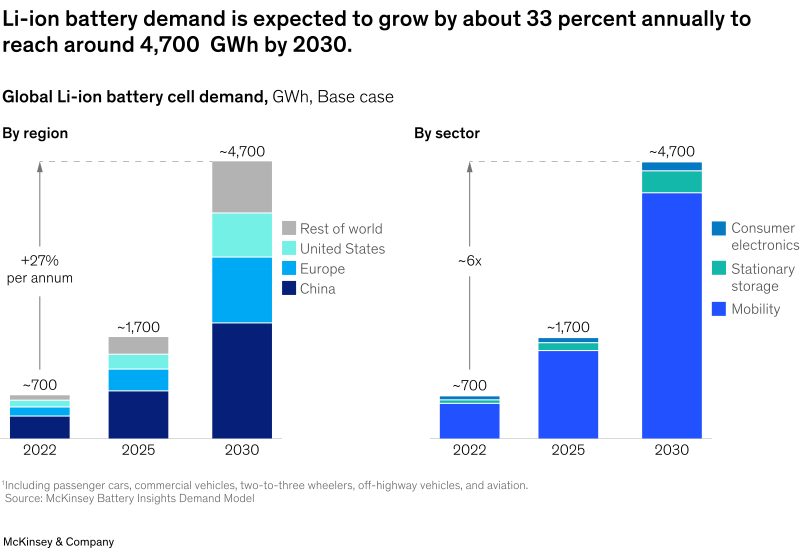
(Source: McKinsey & Company)
Lithium-ion batteries can help us turn the tide on climate change by providing a way to store and use energy more sustainably, to ultimately decarbonize electrification.
Reducing the cost of lithium-ion batteries will be a huge step toward expanding our power grids’ storage capacity. According to the IEA, batteries are the most scalable type of grid storage. They are critical to our goal of reaching net zero by 2050.
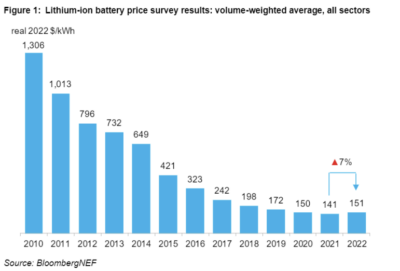
(Source: BloombergNEF)
To ramp up the global use of batteries, we’ll need innovations in several industries across materials, transport, and manufacturing. Below are some sectors that are helping to accelerate a clean energy transition:
Legacy automobile manufacturers are expanding investments in battery-powered electric vehicles. Several companies are planning to sell these vehicles exclusively by 2035. This development will expand access and drive down prices.
Industry leaders are investing in battery-powered electric aircraft. In recent years, we’ve seen a significant increase in funding, technological advancements, and regulatory clarity.
By 2030, the global residential battery market is expected to grow to $28 billion. The U.S., Europe, Australia, and Japan are leading the charge in investments in rooftop solar and home batteries for inverters and home appliances.